The Power of Neurolinguistic Programming
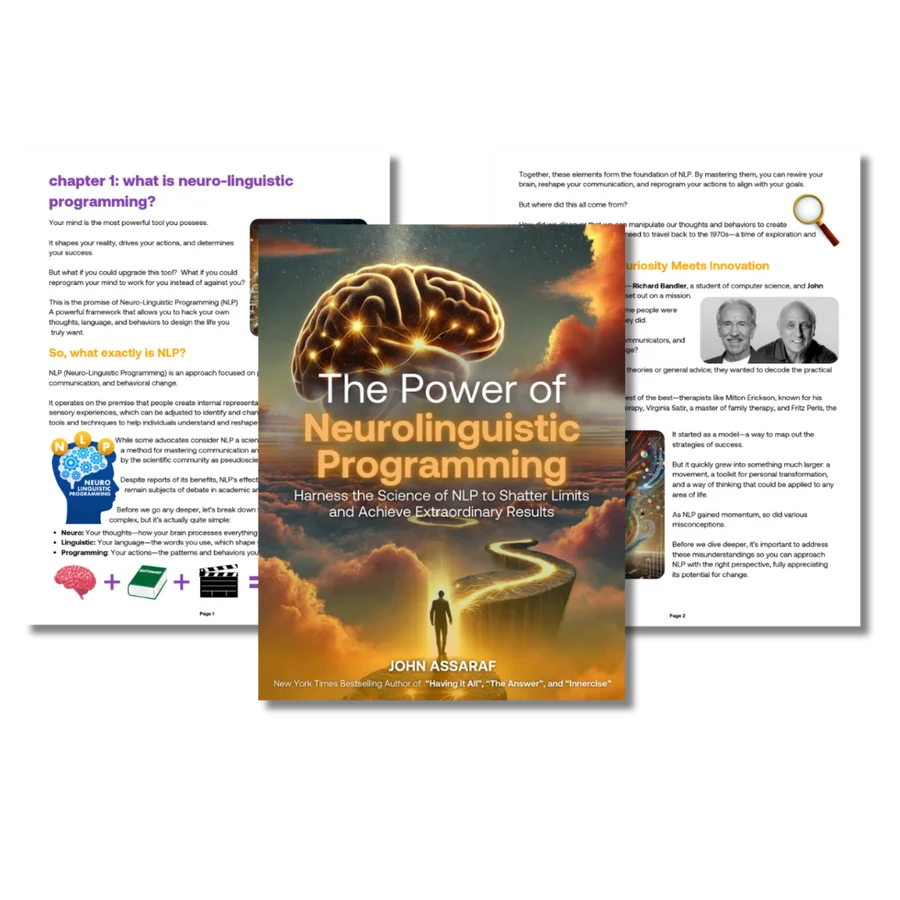
A 19-page guide to eight neurolinguistic programming techniques, written in plain English: what the name actually means, and how to practice anchoring, reframing, the swish pattern and five more on your own thinking.
Written by John Assaraf, founder of NeuroGym. Free, no payment details, delivered the moment you sign up.
Yes, send me the free guide
Enter your name and email below.
This is an educational guide, not therapy and not a diagnosis. The techniques in it are presented as the guide teaches them. If you are working through trauma, a phobia or persistent low mood, please do it with someone licensed to help.
| Format | Free PDF guide, 19 pages in 4 chapters |
|---|---|
| Author | John Assaraf, founder and CEO of NeuroGym |
| Price | Free, no payment details |
| Delivery | Download after you enter your name and email |
| Best for | Readers who want NLP explained in plain English, with practice steps to try |
What is The Power of Neurolinguistic Programming?
The Power of Neurolinguistic Programming is a free 19-page PDF guide by John Assaraf, founder of NeuroGym. It defines NLP, traces its origins, lists common misconceptions, maps the work onto three brain networks, and then teaches eight techniques with practice steps: anchoring, reframing, the swish pattern, rapport building, visualization, modeling, belief change and the meta model.
A final chapter shows uses in personal development, professional growth, therapy and healing, and everyday communication. The guide describes NLP as a blend of art and science rather than strict scientific method, and says real mastery comes from hands-on practice, not reading alone. It is educational and not a substitute for therapy.
The guide’s pages also invite readers to NeuroGym’s free Brainathon training. We are a NeuroGym affiliate, so if you register through our links we may earn a commission at no extra cost to you.
What you get
5 sections, 19 pages. It is a guide rather than a course: you can read it in one sitting and start the same evening.
What the three words actually mean
Neuro for your thoughts, linguistic for the language you use about them, programming for the patterns that result. The guide opens by stripping the jargon off the name, which is most of what makes the field confusing from the outside.
The three brain networks the guide maps the work onto
The default mode network behind your inner narrative, the central executive network behind focus and decisions, and the salience network that decides what you notice. The guide uses these to explain where each technique is aimed.
Anchoring
Pairing a deliberate physical cue, a touch, a gesture or a word, with a state you want on demand, so the cue can call it back later. The guide covers how to set one up and how to keep it working.
Reframing
Holding the same situation and changing the meaning attached to it, on the basis that the emotion follows the meaning rather than the event. The guide treats this as the technique with the widest use, from criticism to setbacks.
The swish pattern
A visual routine for putting a chosen behavior in the place of an unwanted one, rehearsed until the replacement is the one that arrives first. Written as steps you can follow on your own.
What are the chapters of The Power of Neurolinguistic Programming?
The PDF runs in 4 chapters, in this order:
- What is neuro-linguistic programming?
- The neuroscience behind NLP
- Core NLP techniques and how to practice them
- Practical applications of NLP
Who is this guide for?
It is a good fit if most of these describe you:
- You keep hearing about NLP and want a plain-English definition.
- You want practice steps for anchoring, reframing and the swish pattern.
- You want to see how the guide connects NLP to brain networks such as the default mode network.
- You are curious about uses at work, such as rapport building and active listening.
Skip it, or look elsewhere, if any of these is true:
- You need a research-grade treatment of NLP. The guide itself calls it a blend of art and science, not strict scientific method.
- You want therapy for trauma or a phobia. Work with a licensed professional.
- You want to master NLP from reading alone. The guide says mastery comes from practice.
John Assaraf

John Assaraf is the founder and CEO of NeuroGym and a New York Times bestselling author. He was featured in “The Secret” and has spent decades on the brain science behind why people do what they do, after two decades running companies at scale.
“Your mind is software. Most people accept the version they were handed. NLP is what happens when you decide to ship a new release.”
John Assaraf, founder of NeuroGym
Read our full profile of John Assaraf.
- The Secret
- New York Times
- CNN
- Larry King Live
- Ellen
- Forbes
Your free copy of The Power of Neurolinguistic Programming
Enter your name and email and the guide reaches you straight away. Then we will show you the next step, including Brainathon 3.0, his free live summit.
- Instant delivery
- Completely free, no payment details
- Leave the list at any time
Get your free guide now
A 19-page guide, yours in your inbox the moment you sign up.
Questions about the guide
Is The Power of Neurolinguistic Programming really free?
Yes. It is a free guide from John Assaraf and NeuroGym. You give a first name and an email address and the download reaches you straight away. No payment details are asked for.
What does NLP stand for?
Neurolinguistic programming. Neuro for your thoughts, linguistic for the language you use about them, and programming for the patterns those two produce. The guide opens by unpacking the name, because the term itself is what puts most people off.
What is inside the guide?
19 pages in four chapters: what NLP means in plain English, the neuroscience the guide maps it onto, eight techniques with practice steps (anchoring, reframing, the swish pattern, rapport building, visualization, modeling, belief change and the meta model), and practical applications. Each technique is written as something you can practice on your own.
Is this a substitute for therapy?
No. It is an educational guide that explains techniques so you can understand and practice them. It is not therapy, it does not diagnose anything, and it does not replace care from a qualified professional. For trauma, a phobia or persistent low mood, work with someone licensed.
Can I do NLP on myself?
The guide is written for self-practice: each technique has practice steps. For reframing, for example, you pick a situation you see negatively, ask yourself what else it could mean, and choose a new interpretation. The guide also says real mastery comes from hands-on practice, and it is not therapy.
Is NLP scientific?
The guide’s own answer is that NLP draws on neuroscience and psychology but is a blend of art and science, designed for practical application rather than strict scientific methodology. Read the techniques as practices to try, and judge them by whether they help you rather than as settled science.
What are the three brain networks in NLP?
The guide maps the work onto three networks. The default mode network is active during self-talk and daydreaming, where your internal narrative plays out. The central executive network handles focus, decisions and problem-solving. The salience network filters what deserves your attention.
What is the swish pattern?
A visualization routine for replacing an unwanted behavior with a better one. In the guide you picture the unwanted behavior vividly, then a contrasting image of the behavior you want, and rehearse swapping one for the other until the replacement is the one that arrives first.
What happens to my email address?
We send you the guide, and occasionally new reviews of the programs we cover. We do not sell or share the address, and every email has an unsubscribe link.