The Power of Gratitude
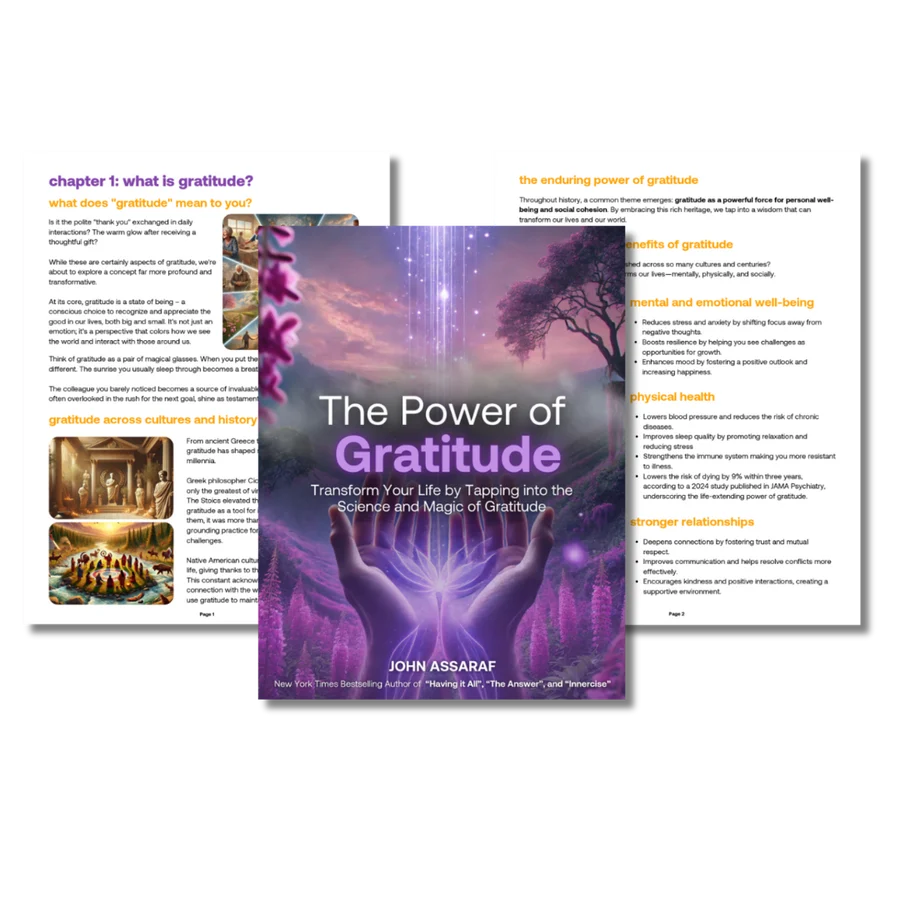
A 27-page, neuroscience-backed guide on what gratitude actually does inside your brain, and how to build a practice that takes less than five minutes a day.
Written by John Assaraf, founder of NeuroGym. Free, no payment details, delivered the moment you sign up.
Yes, send me the free guide
Enter your name and email below.
| Format | Free PDF guide, 27 pages in 6 chapters |
|---|---|
| Author | John Assaraf, founder and CEO of NeuroGym |
| Price | Free, no payment details |
| Delivery | Download after you enter your name and email |
| Best for | Readers who want a short daily practice and the brain science behind it |
What is The Power of Gratitude?
The Power of Gratitude is a free 27-page PDF guide by John Assaraf, founder of NeuroGym. It explains what gratitude does in the brain, with sections on dopamine, serotonin and oxytocin and on the prefrontal cortex, the amygdala and the hypothalamus. It then turns to practice: six ways to build a daily habit, six barriers that derail it, and ways to apply it to health, relationships, work, money and your surroundings.
It also includes two short fill-in-the-blank exercises, a six-statement gratitude questionnaire called the GQ-6 to gauge where you start, and a section on Arigato Money, a Japanese approach to saying thank you to money as it comes and goes.
The guide’s pages also invite readers to NeuroGym’s free Brainathon training. We are a NeuroGym affiliate, so if you register through our links we may earn a commission at no extra cost to you.
What you get
5 sections, 27 pages. It is a guide rather than a course: you can read it in one sitting and start the same evening.
The three brain chemicals gratitude releases
Dopamine, serotonin and oxytocin, and the part each one plays in mood, stability and feeling connected to other people.
What the research says about gratitude and cortisol
The guide cites fMRI work on how a gratitude practice calms the amygdala, the part of the brain that runs the fear response, and engages the hypothalamus, which governs sleep and stress.
Six ways to build the practice into a normal day
From a two-minute journal to gratitude at the dinner table. Six options rather than one prescription, so you can pick the one that survives your actual schedule.
The six barriers that stop most people
Negativity bias, the comparison trap, a schedule with no room in it, difficult emotions, expectations that do not match reality, and gratitude fatigue. Naming them is most of the work.
The ripple effect
What the research shows about how one person’s practice changes the people around them, at home and at work.
What are the chapters of The Power of Gratitude?
The PDF runs in 6 chapters, in this order:
- What is gratitude?
- The science of gratitude
- Practical ways to cultivate gratitude
- Overcoming barriers to gratitude
- Integrating gratitude into every area of your life
- The ripple effect of gratitude
Who is this guide for?
It is a good fit if most of these describe you:
- You want a practice you can fit into a few minutes a day, with several formats to choose from.
- You want the brain chemistry explained in plain language before you commit to a habit.
- You are curious how gratitude applies to money, work and relationships, not only to mood.
- You would rather read a short guide in one sitting than start a full course.
Skip it, or look elsewhere, if any of these is true:
- You want treatment for depression or anxiety. This is an educational guide, not therapy.
- You want the full NeuroGym program. The guide is a free introduction, and its pages also point to the NeuroGym app and to the free Brainathon training.
- You want original research. The guide summarizes findings, so check any study that matters to you.
John Assaraf

John Assaraf is the founder and CEO of NeuroGym and a New York Times bestselling author. He was featured in “The Secret” and has spent decades on the brain science behind why people do what they do, after two decades running companies at scale.
“Gratitude is not just a feeling. It is a state of being, a conscious choice to recognize the good. The more you practice it, the more your brain rewires to notice it.”
John Assaraf, founder of NeuroGym
Read our full profile of John Assaraf.
- The Secret
- New York Times
- CNN
- Larry King Live
- Ellen
- Forbes
Your free copy of The Power of Gratitude
Enter your name and email and the guide reaches you straight away. Then we will show you the next step, including Brainathon 3.0, his free live summit.
- Instant delivery
- Completely free, no payment details
- Leave the list at any time
Get your free guide now
A 27-page guide, yours in your inbox the moment you sign up.
Questions about the guide
Is The Power of Gratitude really free?
Yes. It is a free guide from John Assaraf and NeuroGym. You give a first name and an email address, and the download reaches you straight away. No payment details are asked for.
What is inside the guide?
27 pages covering the brain chemistry behind gratitude, what research says about its effect on the stress response, six ways to build a daily practice, the six barriers that most often derail one, and how the effect spreads to the people around you.
How long does the practice take?
The guide is built around a practice of under five minutes a day. The point of offering six different formats is that the one you will actually repeat matters more than the one that looks most thorough.
Who is John Assaraf?
The founder and CEO of NeuroGym and a New York Times bestselling author. He appeared in "The Secret" and has spent decades on the brain science behind behavior and performance.
What hormone is released during gratitude?
According to the guide, practicing gratitude stimulates three chemicals: dopamine, the reward chemical; serotonin, which it ties to mood; and oxytocin, the bonding hormone. It also describes effects on the prefrontal cortex, the amygdala and the hypothalamus. These are the guide’s claims, drawn from the research it cites.
What are the benefits of gratitude?
The guide groups them into social benefits such as trust, connection and empathy, and cognitive benefits such as mental clarity, problem-solving and less reactivity to stress. It also cites a survey in which over 90% of American teens and adults said expressing gratitude made them happy. They are the guide’s claims, so read them as a starting point rather than a promise.
What is the Gratitude Questionnaire-6?
The GQ-6 is a six-statement self-assessment of how grateful you tend to be. You rate each statement from 1, strongly disagree, to 7, strongly agree, and two of the six are reverse scored. The guide includes it so you can see your baseline before you start, and credits it to McCullough and colleagues, 2002.
Can gratitude help with money?
The guide has a section on career and finances and one on Arigato Money, popularized by Ken Honda, which means saying thank you each time you pay a bill, receive a paycheck or make a purchase. It is presented as a mindset practice. It is not financial advice and does not promise income.
What happens to my email address?
We send you the guide, and occasionally new reviews of the programs we cover. We do not sell or share the address, and every email has an unsubscribe link.