The Power of Cognitive Behavioral Therapy
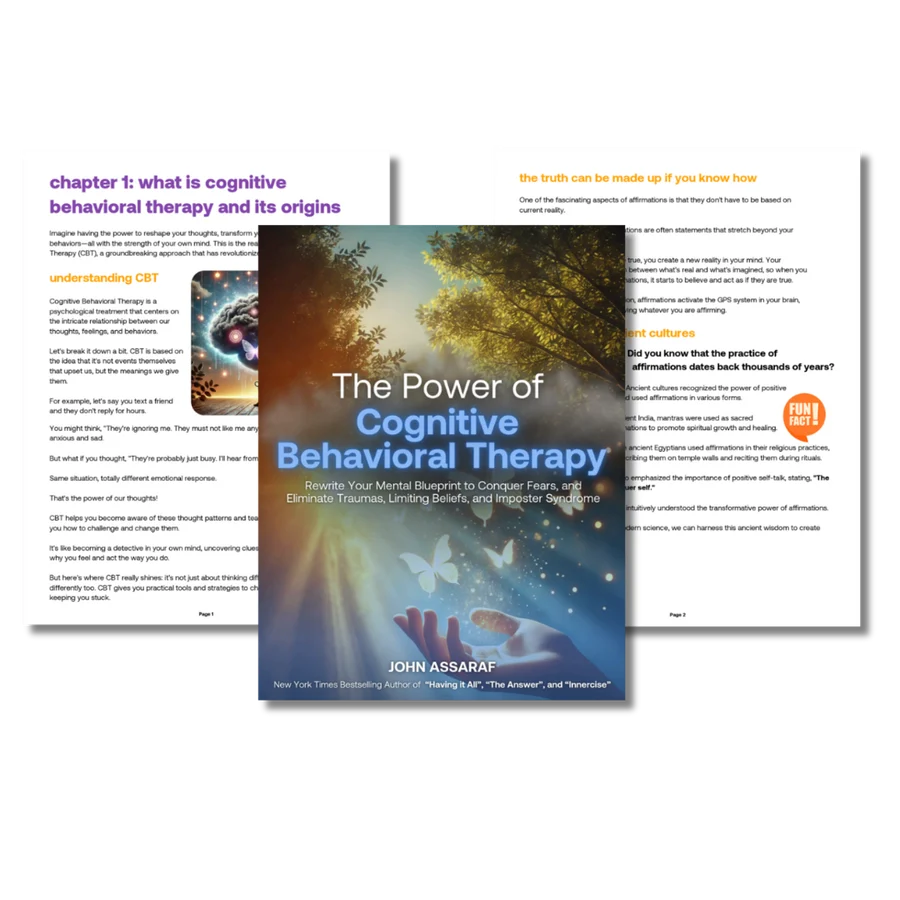
A 25-page guide to the five cognitive behavioral therapy skills with the most evidence behind them, written so you can put them to work on your own thinking.
Written by John Assaraf, founder of NeuroGym. Free, no payment details, delivered the moment you sign up.
Yes, send me the free guide
Enter your name and email below.
This is an educational guide, not therapy and not a diagnosis. It does not replace care from a qualified professional. If you are dealing with trauma, a phobia or persistent low mood, please work with someone licensed to help.
| Format | Free PDF guide, 25 pages in 6 chapters |
|---|---|
| Author | John Assaraf, founder and CEO of NeuroGym |
| Price | Free, no payment details |
| Delivery | Download after you enter your name and email |
| Best for | Readers who want to understand CBT and try its self-help techniques, with a professional for anything clinical |
What is The Power of Cognitive Behavioral Therapy?
The Power of Cognitive Behavioral Therapy is a free 25-page PDF guide by John Assaraf, founder of NeuroGym. It explains what CBT is and where it came from, then teaches the core skills as exercises: spotting automatic thoughts, cognitive restructuring, a five-step thought record, behavioral activation and a fear hierarchy rated on a 0 to 100 distress scale.
Later chapters cover the benefits the guide attributes to CBT, how CBT differs from other therapies, common criticisms with the guide’s replies, and where the field is heading, including online delivery. It is educational, and it says plainly that it does not replace care from a licensed professional.
The guide’s pages also invite readers to NeuroGym’s free Brainathon training. We are a NeuroGym affiliate, so if you register through our links we may earn a commission at no extra cost to you.
What you get
5 sections, 25 pages. It is a guide rather than a course: you can read it in one sitting and start the same evening.
The insight the whole method rests on
That distress tends to come less from an event than from the meaning your mind attaches to it. The guide works through how that happens and why noticing it is the first thing that changes.
Becoming a thought detective
The common cognitive distortions, named so you can catch them: all-or-nothing thinking, catastrophizing, personalization and overgeneralization. Seeing one as it happens is what makes it optional.
Cognitive restructuring in plain English
A step-by-step way to question a negative thought, weigh the evidence for and against it, and land on something more balanced. The guide is explicit that this is not affirmations.
The fear hierarchy
The graded exposure structure used in clinical practice, broken into steps small enough to start with the least frightening one rather than the thing you are avoiding.
Behavioral activation
The part most people skip: sometimes action has to come before the change in thinking, not after it. The guide covers how to build behavior that supports the way you want to think.
What are the chapters of The Power of Cognitive Behavioral Therapy?
The PDF runs in 6 chapters, in this order:
- What CBT is and where it came from
- The core elements and techniques of CBT
- The benefits of CBT
- What sets CBT apart from other therapies
- Applying CBT in everyday life and answering common criticisms
- The future of CBT
Who is this guide for?
It is a good fit if most of these describe you:
- You want to understand how thoughts, feelings and behavior connect, in plain language.
- You want step-by-step exercises, such as a thought record and a graded list of fears.
- You are thinking about seeing a CBT therapist and want to know what the work involves.
- You want the common objections to CBT answered rather than ignored.
Skip it, or look elsewhere, if any of these is true:
- You are in crisis, or dealing with trauma, a phobia or persistent low mood. Work with a licensed professional, because this guide is not treatment.
- You want a diagnosis or a treatment plan. The guide offers neither.
- You expect a full course. It is a short introduction with a handful of exercises.
John Assaraf

John Assaraf is the founder and CEO of NeuroGym and a New York Times bestselling author. He was featured in “The Secret” and has spent decades on the brain science behind why people do what they do, after two decades running companies at scale.
“It is not events themselves that upset us. It is the meaning we give them. Change the meaning, and the emotion changes with it.”
John Assaraf, founder of NeuroGym
Read our full profile of John Assaraf.
- The Secret
- New York Times
- CNN
- Larry King Live
- Ellen
- Forbes
Your free copy of The Power of Cognitive Behavioral Therapy
Enter your name and email and the guide reaches you straight away. Then we will show you the next step, including Brainathon 3.0, his free live summit.
- Instant delivery
- Completely free, no payment details
- Leave the list at any time
Get your free guide now
A 25-page guide, yours in your inbox the moment you sign up.
Questions about the guide
Is The Power of Cognitive Behavioral Therapy really free?
Yes. It is a free guide from John Assaraf and NeuroGym. You give a first name and an email address and the download reaches you straight away. No payment details are asked for.
Is this a substitute for therapy?
No. It is an educational guide that explains techniques used in cognitive behavioral therapy so you can understand and practice them. It is not therapy, it does not diagnose anything, and it does not replace care from a qualified professional. For trauma, a phobia or persistent low mood, work with someone licensed.
What is cognitive behavioral therapy?
A well-studied approach built on the idea that thoughts, feelings and behavior influence each other, so changing the thinking or the behavior can change how you feel. It is practical and structured, which is why so much of it can be taught rather than only delivered in a session.
What is inside the guide?
25 pages covering five skills: the core insight behind the method, spotting cognitive distortions, cognitive restructuring, the fear hierarchy used for graded exposure, and behavioral activation.
Can I do CBT on my own with a book?
The guide teaches several CBT techniques as self-practice, such as thought records and a graded fear list, step by step. Self-help is not the same as therapy, though. The guide itself says it does not replace a therapist, and for trauma, a phobia or persistent low mood you should work with someone licensed.
How long does CBT take?
According to the guide, CBT is typically short-term and often completed in 12 to 20 sessions. That figure describes therapy with a professional. The exercises in the guide are things you can start on your own, but they are not a substitute for a course of treatment.
What is a thought record?
A tool for tracking how a situation, a thought and an emotion connect. The guide’s version has five steps: write down the situation, note the thoughts that went through your mind, rate the emotion from 0 to 100, challenge and reframe the thought with other evidence, and reflect on how the emotion changed.
What is a fear hierarchy?
A ranked list of fears, each rated from 0 to 100 on the Subjective Units of Distress Scale, which you work through starting with the least distressing. The guide includes the exercise step by step. It is a technique used in graded exposure, and for a serious phobia it should be done with a professional.
What happens to my email address?
We send you the guide, and occasionally new reviews of the programs we cover. We do not sell or share the address, and every email has an unsubscribe link.