Visualization: How to Practice Visualization Meditation and Techniques That Work
Visualization is the practice of picturing what you want to achieve using as many senses as you can. Here is how to practice it as a meditation, five techniques, what research says works best and how NeuroGym builds visualization into daily innercises.
Affiliate disclosure: This article contains affiliate links, which means I may earn a commission if you register through them, at no extra cost to you. This is an independent site, not the official NeuroGym website. NeuroGym is a trademark of its owner. This guide is educational: it is not medical or psychological advice, and it promises no result.
Quick answer
Visualization is the practice of imagining what you want to achieve, using as many senses as you can. The most effective version pictures the steps as well as the result, and pairs the wish with the obstacle and a plan. Five to ten minutes a day is enough. NeuroGym’s innercises build visualization into guided daily sessions.
Pick a session time in your own time zone.
Highlights
- A clear definition, and a note on mental visualization versus data visualization
- Five visualization techniques, from process rehearsal to mental contrasting
- A ten-minute visualization meditation you can do today
- What research says: why picturing the steps beats picturing only the win
- Tips if you cannot “see” pictures clearly in your mind
- A free way to try guided visualization: the NeuroFitness training
| What it is | Imagining what you want to achieve or experience, using as many senses as you can |
|---|---|
| Not to be confused with | Data visualization, which means charts and graphics |
| Best-supported approach | Picture the steps and the obstacles, not only the finished result |
| Daily time needed | Five to ten minutes |
| Research | Mental practice improves performance compared with no practice, though doing the real thing works better |
| NeuroGym method | Innercises: guided sessions with visualization, meditation, affirmations and brain training |
| Free way to start | John Assaraf’s 75-minute NeuroFitness training and the live Brainathon 3.0 |
| Note | Educational, not medical advice |
What is visualization?
Visualization is the practice of picturing in your mind what you want to achieve or experience, using as many senses as you can: what you see, hear, feel, and even smell or taste. It is used by athletes, performers, students and anyone who wants to prepare for something important.
This guide is about mental visualization. If you were looking for data visualization, which means charts and graphics, that is a different topic. Here, visualization is a mental skill you can train.
Does visualization work?
Research on mental practice, which is imagining yourself doing a task, finds that it can improve performance. A 1994 meta-analysis by James Driskell, Carolyn Copper and Aidan Moran in the Journal of Applied Psychology concluded that mental practice improves performance compared with no practice, although doing the real thing is more effective. That is why athletes and musicians use it alongside physical practice, not instead of it.
The way you visualize matters too. Psychologist Gabriele Oettingen found in several studies that people who only indulged in positive fantasies about the future put in less effort and often did worse than people who also considered the obstacles. In one weight-loss study, women with positive fantasies about their success lost less weight than those who pictured the challenges realistically. Her alternative, called mental contrasting, pairs the wish with the obstacle in the way, and it has been linked with more effort and better results for realistic goals.
The lesson is encouraging. Visualization is not a shortcut, it is rehearsal, and rehearsal is most useful when it includes the steps. Picture yourself doing the work, then picture how you will handle the moment it gets hard.
What is visualization meditation?
Visualization meditation combines focused imagery with relaxation. Instead of watching your breath alone, you let your mind form a detailed scene, such as a place, a future moment or a task going well. People use it to reduce stress, to improve focus and to prepare for goals. A few minutes at a time is enough.
A simple ten-minute version:
- Settle. Sit comfortably, close your eyes and take five slow breaths.
- Choose one goal. Pick one specific moment, such as walking into a meeting prepared or finishing a workout.
- Build the scene. Add what you see, hear and feel. Where are you? Who is there? What are you wearing?
- Rehearse the steps. See yourself taking the actions that lead there, one at a time.
- Meet the obstacle. Picture the moment it gets hard, and see yourself responding the way you want to.
- Feel the finish. Spend the last minute on the satisfaction of having done it.
- Come back. Take three breaths, open your eyes and write one action for today.
Pick a session time in your own time zone.
What are the best visualization techniques? Five to try
- Process visualization. Rehearse the actions that lead to the goal, step by step, such as the first call, the first page or the first mile. Researchers contrast this with outcome simulation, which imagines having already reached the goal.
- Outcome visualization with feeling. Imagine the result briefly, in all senses, to remind yourself why you are working. Keep it short and pair it with a step.
- Mental contrasting. Picture the wish, picture the obstacle, then make a plan. Oettingen’s version of this is often taught as WOOP: wish, outcome, obstacle, plan.
- Future-self visualization. Imagine the person you want to become a year from now, and picture what they do on an ordinary day. Then choose one action that person would take today.
- Guided visualization. Follow a recorded or live script that walks you through the scene, which is easier if you are new to it or find it hard to concentrate on your own.
You do not need all five. Start with process visualization and mental contrasting, because they connect the picture to action.
What are some quick visualization exercises?
| Time | Exercise |
|---|---|
| 2 minutes | Before a task, picture yourself doing the first step, and the first obstacle, then begin |
| 5 minutes | Mental contrasting: wish, outcome, obstacle, plan, written in four short lines |
| 10 minutes | The seven-step visualization meditation above |
| Evening | Rehearse tomorrow’s most important task from start to finish |
Pick one and keep it for two weeks. Regularity matters more than length, because the brain responds to what you repeat. Our neuroplasticity guide explains why.
What if you cannot “see” pictures in your mind?
Mental images vary a lot from person to person. Some people see vivid pictures, and others hardly see any. If you do not, you can still visualize: focus on sounds, physical sensations, emotions or the words you would say. A narrated description of the scene works too. The goal is a rich mental rehearsal, not a perfect movie.
How does NeuroGym use visualization?
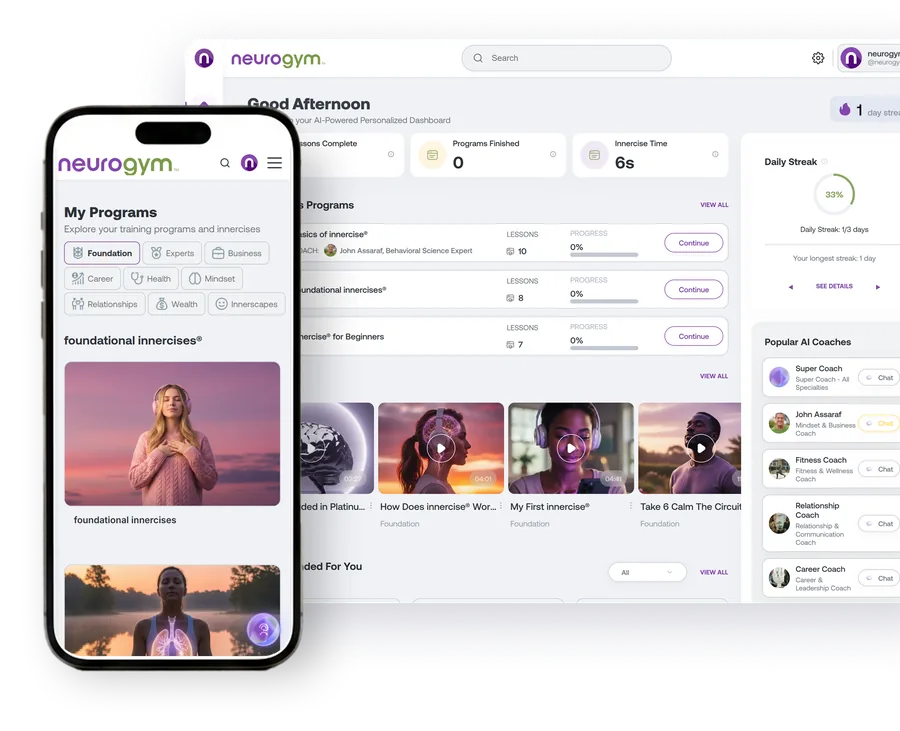
Visualization is one of the building blocks of John Assaraf’s innercise, NeuroGym’s guided brain-training session, which combines visualization, meditation, affirmations and brain-training exercises in about five to fifteen minutes. The idea is that a guided session makes a daily practice easy to keep, which is what turns visualization from an occasional exercise into a habit.
The platform’s Platinum membership includes 700+ innercises, 42+ AI coaches and four live trainings a month, at $97 a month or $497 a year on the official pricing page, with a 7-day money-back guarantee. Our NeuroGym Platinum review lists what each plan includes. To try the method first, the NeuroFitness training and the Brainathon 3.0 are both free.
Seating for the live sessions is limited.
How do you make visualization a habit?
- Attach it to something you already do, like the first five minutes after you wake up. Our morning routine guide shows how.
- Keep it short. Five minutes done daily beats thirty minutes once a week.
- Always end with an action. Write one step you will take today.
- Pair it with the mindset work. If doubts show up, see our guides to self-sabotage and your money mindset.
When should you be careful?
Visualization can bring up strong emotions. If it makes you feel anxious, distressed or reminded of a painful experience, stop, take a few slow breaths and talk to a doctor or licensed professional. This guide is general information and does not replace care. If you are in distress in the United States, call or text 988, the Suicide and Crisis Lifeline.
Our verdict on visualization
Visualization works best as rehearsal. Picture the steps, expect the obstacle, plan for it and finish with one real action. Five to ten minutes a day is enough to start, and a guided session makes it easier to stay consistent. John Assaraf’s free NeuroFitness training and the live Brainathon are a no-cost way to see how NeuroGym teaches it.
What are the pros and cons of visualization practice?
What stands out
- Takes five to ten minutes a day
- Backed by research on mental practice
- Works alongside real action and routines
- Free ways to try a guided method with John Assaraf
- A 7-day money-back guarantee on the NeuroGym membership
Good to know
- It is rehearsal: pair it with a real step each day
- Picture the steps and obstacles, not only the win
- Like any skill, it gets easier with regular practice
- It is educational, not therapy
- Results vary with effort and circumstances
Who is this visualization guide for?
- You want a simple daily practice to support your goals
- You prefer guided sessions to doing it alone
- You want an approach grounded in research, not hype
- You are preparing for a big task, talk or change
- You want a free way to try a guided method first
Start with the free NeuroFitness training or the Brainathon 3.0.
Pick a session time in your own time zone.
Seating for the live sessions is limited.
Check the price and terms on the checkout page.
Frequently asked questions about visualization
What is visualization?
The practice of picturing in your mind what you want to achieve, using as many senses as you can, to prepare for it and stay motivated.
Does visualization really work?
Research on mental practice finds it can improve performance compared with no practice, although doing the real thing is more effective. It works best when you picture the steps and the obstacles, not only the result.
How do you practice visualization meditation?
Settle with a few slow breaths, choose one goal, build the scene with your senses, rehearse the steps, meet the obstacle, feel the finish and write one action for today. Ten minutes is enough.
What are good visualization techniques?
Process visualization, outcome visualization with feeling, mental contrasting (WOOP), future-self visualization and guided visualization.
What is mental contrasting?
A technique from Gabriele Oettingen that pairs the wish with the obstacle in the way and a plan, which has been linked with more effort and better results than positive fantasy alone.
How long should I visualize each day?
Five to ten minutes is enough. Regularity matters more than length.
What if I cannot picture things clearly?
Use other senses: sounds, physical sensations, emotions or a narrated description. A rich rehearsal does not need clear pictures.
Is visualization the same as manifestation?
Visualization is a mental rehearsal that prepares you to act. It works with effort, steps and a plan rather than replacing them.
How does NeuroGym use visualization?
It is part of the innercise, a guided session that combines visualization, meditation, affirmations and brain-training exercises, usually five to fifteen minutes long.
Is there a free way to try a guided method?
Yes. John Assaraf’s NeuroFitness training is a free 75-minute online session, and the live Brainathon 3.0 is free to attend. The membership has a 7-day money-back guarantee.
Related reviews

John Assaraf NeuroFitness Training: Free 75-Minute Class
John Assaraf’s free NeuroFitness training: what the 75-minute session covers on subconscious patterns, identity and the 5 pillars of financial success, how the sessions work and how to join.
Read the review
John Assaraf Brainathon 3.0 Review: Inside the Free Brain and Money Summit
Five brain and performance experts, three hours, no ticket price. What John Assaraf covers in Brainathon 3.0, and who gets the most from it.
Read the review
NeuroGym Platinum Review: Price, What You Get and the 7-Day Guarantee
John Assaraf’s top NeuroGym plan, checked against the official pricing and refund pages: what $97 a month or $497 a year buys, how it differs from Gold, and how the 7-day money-back guarantee works.
Read the review