Neuroplasticity: What It Is, How It Works and Exercises to Train Your Brain
Neuroplasticity is the brain’s ability to change with learning and experience, and it continues into adulthood. Here is what the science says, seven ways to support it, and how short daily innercises put the idea into practice.
Affiliate disclosure: This article contains affiliate links, which means I may earn a commission if you register through them, at no extra cost to you. This is an independent site, not the official NeuroGym website. NeuroGym and Innercise are trademarks of their respective owners. This guide is educational: it is not medical advice and it does not diagnose or treat any condition.
Quick answer
Neuroplasticity is the brain’s ability to reorganize its connections in response to learning and experience, and it continues into adulthood. You can support it by learning new skills, moving your body, sleeping well and practicing in short, regular sessions. John Assaraf’s NeuroGym builds its daily innercise sessions on that idea, and you can try the method free.
Pick a session time in your own time zone.
Highlights
- A plain-English definition of neuroplasticity and how it works
- Real examples: London taxi drivers, musicians and stroke rehabilitation
- Seven ways to support neuroplasticity, with a daily practice you can start today
- What “rewire your brain” and “reprogram the subconscious” really mean
- How NeuroGym’s innercises turn the idea into five to fifteen minutes a day
- Free ways to try it: the Brainathon and the NeuroFitness training
| What it is | The brain’s ability to reorganize its neural connections in response to learning, experience or injury |
|---|---|
| Two kinds | Structural (physical changes) and functional (changes in how networks work) |
| Does it last into adulthood? | Yes. The brain stays adaptable, though the developing brain is more plastic |
| Ways to support it | New skills, movement, sleep, mindfulness and regular practice |
| Daily time needed | Five to fifteen minutes is enough to start a practice |
| NeuroGym method | Innercises: short guided sessions of visualization, meditation, affirmations and brain training |
| Free way to start | Brainathon 3.0 and the 75-minute NeuroFitness training with John Assaraf |
| Note | Educational, not medical advice |
What is neuroplasticity?
Neuroplasticity, also called neural plasticity or simply plasticity, is the brain’s ability to reorganize and rewire its neural connections. It lets the brain adapt after learning, a change in your environment, an injury or a sensory or cognitive difference. The most important point for anyone reading this: that adaptability continues into adulthood.
The idea has a long history. In 1890 the psychologist William James used the word “plasticity” for a structure weak enough to yield to an influence but strong enough not to yield all at once. In the early 1900s Santiago Ramón y Cajal described structural changes in the adult brain, and in 1949 Donald Hebb’s book developed the learning rule that became known as Hebbian learning: connections between neurons that are active together get stronger. In 1964 Marian Diamond produced the first scientific evidence of anatomical brain plasticity.
For a long time people believed the brain stopped changing after childhood. Research in the later twentieth century showed the opposite, and it is the reason brain training makes sense at any age.
How does neuroplasticity work?
Scientists describe two kinds. Structural plasticity is a physical change in the brain, such as new connections between neurons. Functional plasticity is a change in how networks of neurons work, for example when one part of the brain takes on a task that another part used to handle.
The everyday version is simple. Each time you repeat a thought, a skill or a habit, the connections involved are used again and strengthen, and the ones you stop using weaken. That is why a skill that feels awkward on day one feels natural after weeks of practice, and why repetition, more than intensity, is what changes the brain.
Can the adult brain really change?
Yes. Three well-known examples show it. London taxi drivers: Eleanor Maguire documented changes in the hippocampus, a region involved in memory and navigation, that were associated with learning the layout of London. Musicians: studies often find more gray and white matter in the motor, auditory and cerebellar regions they use most. Stroke rehabilitation: therapies such as constraint-induced movement therapy and music-supported therapy are used because they encourage the brain to reorganize around the affected area.
The developing brain is more plastic than the adult brain, and some research shows genes tied to synaptic plasticity are expressed less in later life, particularly after about age 70. The takeaway is not that change stops. It is that regular practice matters more the longer you wait to start, so the best time to begin is now.
How can you train your neuroplasticity? Seven ways
- Learn something new and a little hard. A language, an instrument, a dance or a new technical skill asks your brain to build new connections. Choose something you can practice a little every day.
- Practice in short, regular sessions. Fifteen minutes daily beats two hours once a week, because the connections are strengthened by repetition.
- Move your body. Exercise supports the brain’s health and your ability to learn, and a daily walk counts.
- Protect your sleep. Sleep is when the brain consolidates what you learned. Most adults need seven or more hours.
- Practice mindfulness or meditation. Calming the mind helps you focus on what you are practicing and manage stress.
- Keep your attention on one thing. Learning sticks when you are alert and engaged, so put the phone away while you practice.
- Use a purpose. Practice with a clear reason, such as a goal you care about, so effort feels worth it.
None of these needs special equipment. What they share is repetition with attention, which is also the heart of how NeuroGym teaches.
What are some neuroplasticity exercises for daily life?
| Time | Exercise |
|---|---|
| 5 minutes | A guided visualization of a goal you want, or three minutes of focused breathing followed by two minutes of writing one goal |
| 15 minutes | A short brisk walk while listening to a lesson, or fifteen minutes on a language or an instrument |
| 30 minutes | A new skill practiced with full attention, followed by a short note on what you learned |
Choose one row and keep it for two weeks before you add anything. The point is to build a daily habit, because the brain responds to what you do repeatedly. For the first row, our visualization guide has a ten-minute practice.
What does “rewire your brain” or “reprogram the subconscious” mean?
These popular phrases describe neuroplasticity in everyday words. “Rewire your brain” means changing habits of thought and action by repeating new ones until they become automatic. “Reprogram the subconscious” points to the same thing from another angle: much of what we do runs on habit and belief we do not examine, and practice can change those patterns.
It happens gradually, through repetition. Nobody changes a deep habit in a weekend, and that is exactly why short daily practice is the model NeuroGym uses.
What are innercises?
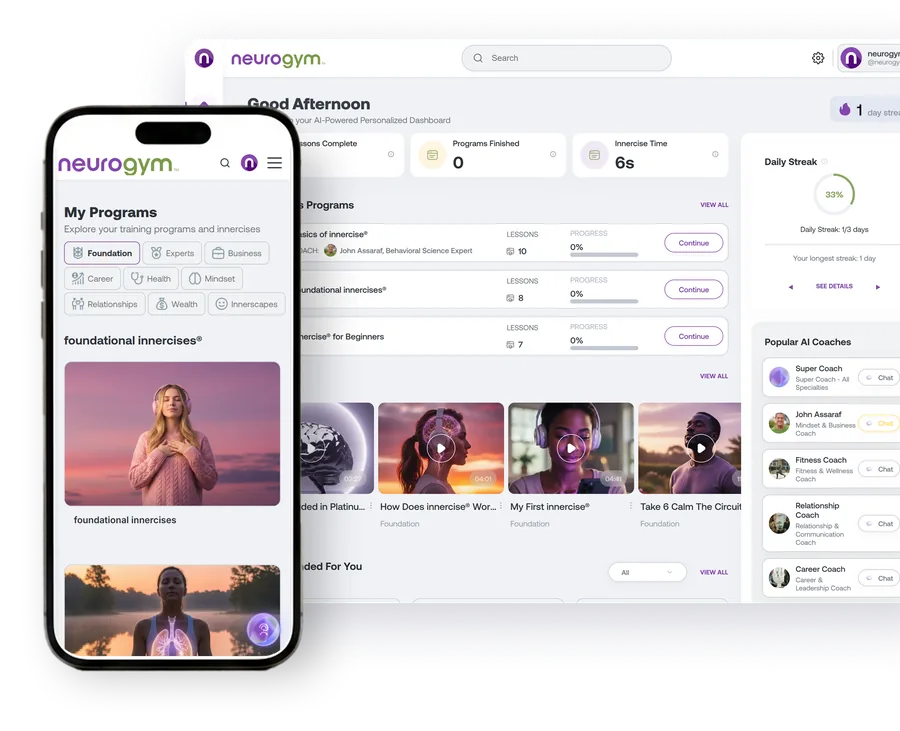
Innercise is NeuroGym’s name for a guided brain-training session. John Assaraf, the founder and CEO of NeuroGym, built the method on the idea that you can train the brain the way you train the body: with short, repeatable sessions of visualization, meditation, affirmations and brain-training exercises. A typical innercise takes about five to fifteen minutes, which is why it fits into a morning routine or a lunch break.
NeuroGym describes the daily practice as the layer that trains skills and habits, and its app, NeuroGym Brain Training, holds 4.9 out of 5 on the US App Store. The platform adds AI coaches, live trainings with John and a library of programs, including Winning the Game of Procrastination, Fear and Money. Our NeuroGym Platinum review lists what each plan includes.
Pick a session time in your own time zone.
How can you try this method for free?
There are two free doors. The first is John Assaraf’s NeuroFitness training, a free 75-minute online session offered several times a day, which our NeuroFitness training page explains in full. The second is the free live Brainathon 3.0, a three-hour summit with five experts that runs most Saturdays: see our Brainathon 3.0 review.
If you like the method and want the daily practice, NeuroGym’s membership has a 7-day money-back guarantee. Start free, see how it feels, and decide at your own pace.
Seating for the live sessions is limited.
When should you talk to a professional?
A guide like this is general information. If you have concerns about memory, mood, an injury or a diagnosis, talk to a doctor or a licensed professional, because training exercises do not replace care. If you are in distress in the United States, call or text 988, the Suicide and Crisis Lifeline.
Our verdict on training your brain with innercises
Neuroplasticity is good news: the adult brain keeps changing, and what you repeat is what it learns. A short daily practice, protected sleep, movement and a skill worth learning are all it takes to start. If you want that practice guided, NeuroGym’s innercises give you a five to fifteen minute format, and you can try the method free with the NeuroFitness training or the Brainathon.
What are the pros and cons of brain training with innercises?
What stands out
- Five to fifteen minutes a day is enough to start
- Guided sessions you can do anywhere, from a phone
- Free ways to try the method first
- Built by John Assaraf, founder and CEO of NeuroGym
- A membership with a 7-day money-back guarantee
Good to know
- Like any practice, it rewards daily consistency
- Change is gradual: give it weeks, not days
- The free trainings are an introduction to the daily practice
- It is educational, not medical care
- Choose a quiet time slot you can keep
Who can benefit from neuroplasticity training?
- You want a science-based, practical view of how your brain changes
- You prefer short daily practice over long courses
- You are working on habits, focus or mindset
- You want to try a method free before you commit
- You are curious about what “rewire your brain” really means
Start with the free NeuroFitness training or the Brainathon 3.0.
Pick a session time in your own time zone.
Seating for the live sessions is limited.
Check the price and terms on the checkout page.
Frequently asked questions about neuroplasticity
What is neuroplasticity in simple terms?
It is the brain’s ability to change and reorganize its connections in response to learning, experience or injury. The brain stays adaptable into adulthood.
Can you rewire your brain as an adult?
Yes. The adult brain keeps changing with practice, although the developing brain is more plastic. Regular, repeated practice is what produces change.
What are the two types of neuroplasticity?
Structural plasticity, which is a physical change such as new connections between neurons, and functional plasticity, which is a change in how networks of neurons work.
What are good neuroplasticity exercises?
Learning a new skill or language, short daily practice sessions, regular movement, good sleep and mindfulness. Choose one you can keep daily.
How long does it take to change your brain?
Change is gradual and comes from repetition. Most people notice a skill feel more natural after several weeks of regular practice.
What is an innercise?
NeuroGym’s name for a guided brain-training session of visualization, meditation, affirmations or brain-training exercises, usually five to fifteen minutes long.
Who created innercises?
John Assaraf, the founder and CEO of NeuroGym and a two-time New York Times bestselling author.
Is there a free way to try NeuroGym?
Yes. John Assaraf’s NeuroFitness training is a free 75-minute online session, and the live Brainathon 3.0 is free to attend. NeuroGym’s membership has a 7-day money-back guarantee.
Does neuroplasticity decrease with age?
The developing brain is more plastic than the adult brain, but the brain keeps adapting throughout life, which is why regular practice remains worthwhile at any age.
Is this medical advice?
No. This guide is educational. For concerns about memory, mood or an injury, talk to a doctor or licensed professional.
Related reviews

John Assaraf NeuroFitness Training: Free 75-Minute Class
John Assaraf’s free NeuroFitness training: what the 75-minute session covers on subconscious patterns, identity and the 5 pillars of financial success, how the sessions work and how to join.
Read the review
John Assaraf Brainathon 3.0 Review: Inside the Free Brain and Money Summit
Five brain and performance experts, three hours, no ticket price. What John Assaraf covers in Brainathon 3.0, and who gets the most from it.
Read the review
NeuroGym Platinum Review: Price, What You Get and the 7-Day Guarantee
John Assaraf’s top NeuroGym plan, checked against the official pricing and refund pages: what $97 a month or $497 a year buys, how it differs from Gold, and how the 7-day money-back guarantee works.
Read the review