Money Mindset: Scarcity, Abundance and How to Change Yours
Your beliefs about money shape the choices you make with it. Here is what a scarcity mindset and an abundance mindset really are, what researchers call money scripts, seven ways to shift yours and a free training from John Assaraf on income and identity.
Affiliate disclosure: This article contains affiliate links, which means I may earn a commission if you register through them, at no extra cost to you. This is an independent site, not the official NeuroGym website. NeuroGym is a trademark of its owner. This guide is educational: it is not financial, legal, tax or investment advice, and it promises no income or result.
Quick answer
A money mindset is the set of beliefs and habits you hold about money, and it shapes how you earn, spend, save and invest. A scarcity mindset assumes there is never enough, while an abundance mindset assumes there are opportunities to create more. John Assaraf’s NeuroGym offers a free training on income and identity.
Pick a session time in your own time zone.
Highlights
- A clear definition of money mindset, scarcity mindset and abundance mindset
- The four money scripts that researchers have identified
- What “money blocks” are, with examples you can recognize
- Seven practical ways to shift your mindset, starting this week
- How NeuroGym approaches money mindset, and the free ways to try it
- A plain note that this is education, not financial advice
| What it is | The beliefs, attitudes and habits you hold about money |
|---|---|
| Scarcity mindset | The assumption that there is never enough, which narrows attention and decisions |
| Abundance mindset | The belief that opportunities exist and can be created |
| Money scripts | Four belief patterns identified in a 2011 study of 422 people |
| Where beliefs come from | Usually childhood and family experience |
| Free way to go deeper | John Assaraf’s 75-minute NeuroFitness training on income, wealth and identity |
| NeuroGym programs | Winning the Game of Money (Platinum), plus 7 Days to a Millionaire Mindset and 100 Days to Financial Success |
| Note | Educational, not financial advice |

What is a money mindset?
A money mindset is the collection of beliefs, attitudes and habits you hold about money: what it is for, whether it is easy or hard to get, what it says about a person and what you deserve. Most of it sits below conscious thought, which is why two people with the same salary can behave very differently with it.
The idea matters because beliefs drive behavior. If you believe money is hard to come by, you tend to play defense. If you believe opportunities can be created, you tend to look for them. Neither belief is a guarantee of anything, but each shapes where your attention goes every day.
What are the four money scripts?
Psychologist Brad Klontz and colleagues studied money beliefs in a 2011 paper that tested 72 money-related beliefs with 422 people and identified four belief patterns, which they called money scripts. Three of the four were significantly correlated with income and net worth. The researchers describe the scripts as typically unconscious beliefs about money that are developed in childhood and influence adult behavior.
| Money script | What it looks like |
|---|---|
| Money avoidance | Seeing wealth as bad or having less as virtuous, and quietly holding back from doing well |
| Money worship | Believing more money will solve life’s problems, which can lead to overspending |
| Money status | Tying self-worth to net worth and comparing yourself with others |
| Money vigilance | Valuing saving, frugality and discretion, which has real benefits but can bring financial anxiety if taken too far |
People rarely fit one script exactly. Most have one that stands out, and seeing which one is a useful first step, because you cannot change a belief you have not noticed.
What is a scarcity mindset?
A scarcity mindset is the habit of assuming there is never enough: not enough money, time or opportunity. It is a natural response to real constraints, and researchers have studied how powerful it is. In their 2013 book Scarcity, Sendhil Mullainathan and Eldar Shafir argue that scarcity captures the mind, leaving less mental bandwidth for everything else.
Other research summaries describe the same effect. Scarce money or time puts a strain on thinking and can bring more impulsive decisions, lower performance on thinking tasks and more forgetfulness, and decisions made under time pressure are often rushed. The lesson is not that you are doing anything wrong. It is that tight situations narrow attention, so deliberately widening it helps.
What is an abundance mindset?
An abundance mindset is the belief that opportunities exist and that you can create more of them. The term is often traced to Stephen Covey, who contrasted an abundance mentality with a scarcity mentality in his 1989 book The 7 Habits of Highly Effective People: the first assumes there is plenty to go around, the second treats every gain as someone else’s loss.
An abundance mindset is not wishful thinking and it does not mean ignoring a budget. It means paying attention to what you can build, learn and offer, while still making practical decisions. It is a lens, and the actions you take through it are what produce results.
| Scarcity mindset | Abundance mindset | |
|---|---|---|
| Core belief | There is never enough | There are opportunities to create more |
| Attention | On what is missing | On what is possible |
| Decisions | Often rushed or defensive | More considered and long-term |
| Others | Success is someone else’s loss | Others’ success is information and inspiration |
What are money blocks?
Money blocks are limiting beliefs about money that quietly hold you back. They often sound like facts: “Money is hard to make,” “Rich people are greedy,” “I do not deserve to earn more” or “Nice people do not talk about money.” The money avoidance script is a good example: it ties wealth to something negative, so the person holds back without noticing.
The way to loosen a money block is to make it visible. Write down the belief, notice where it came from and look for real evidence on the other side, such as people who earn well and are generous, or times you have created value yourself.
How do you change your money mindset? Seven ways
- Notice your script. Which of the four fits you best? Write down three beliefs about money you grew up with.
- Challenge one belief at a time. Put the belief and the evidence against it side by side on paper.
- Name a specific goal. “Build a three-month cushion” or “learn a skill that earns more” is better than “be rich.”
- Make the basics visible. Know what comes in and what goes out. Clarity reduces the anxiety that feeds scarcity thinking.
- Learn and add value. An abundance mindset grows when you build a skill other people will pay for.
- Choose your company. Spend time with people who treat money as a tool and opportunity as something you can create.
- Practice daily. Short, repeated practice, such as a few minutes of visualizing your goal or reading it aloud, trains the new belief until it is automatic.
This is educational, not financial advice. For decisions about debt, investing or taxes, talk to a qualified professional.
Pick a session time in your own time zone.
How does NeuroGym approach money mindset?
John Assaraf’s NeuroGym teaches that many financial results follow subconscious patterns, and that those patterns can be retrained with short, regular practice called innercises. The free NeuroFitness training is titled “Rewire Your Brain for More Income, Wealth & Total Life Success,” and it covers how to upgrade your identity to match your goals and five pillars of financial success.
The free live Brainathon 3.0 approaches the same theme from five angles: beliefs, fear responses and identity patterns behind money decisions. See our Brainathon 3.0 review and our NeuroFitness training page.
Seating for the live sessions is limited.
What are NeuroGym’s money programs?
NeuroGym’s membership includes two courses on the subject in both Gold and Platinum: 7 Days to a Millionaire Mindset and 100 Days to Financial Success. Platinum adds the Winning the Game of Money program, together with Winning the Game of Fear and Winning the Game of Procrastination, 700+ innercises and four live trainings a month. On the official pricing page Gold is $47 a month or $297 a year and Platinum is $97 a month or $497 a year, with a 7-day money-back guarantee. Our NeuroGym Platinum review compares the two.
Our guides to procrastination and self-sabotage cover two patterns that often travel with money beliefs.
Our verdict on changing your money mindset
Your beliefs about money are learned, which means they can be re-learned. Notice your script, pick one belief to challenge, set one specific goal and practice a little each day. If you want a guided starting point, John Assaraf’s free NeuroFitness training and the live Brainathon are free ways to see how NeuroGym approaches the subject. Nothing here promises income, and the results come from what you do with it.
What are the pros and cons of working on your money mindset?
What stands out
- Simple steps, starting with noticing your own beliefs
- Grounded in published research on money beliefs and scarcity
- Free ways to go deeper with John Assaraf
- Pairs with a budget and real skills, not instead of them
- A 7-day money-back guarantee on the NeuroGym membership
Good to know
- Beliefs change gradually: give it a few weeks
- The steps work best when practiced daily
- Mindset works alongside practical money habits
- This guide is educational, not financial advice
- Individual results vary with effort and circumstances
Who is this money mindset guide for?
- You feel stuck below what you know you are capable of earning
- You notice scarcity thinking or a belief that holds you back
- You want a research-based, practical view of money beliefs
- You want a free way to explore the income and identity side
- You prefer small daily practice to big promises
Start with the free NeuroFitness training or the Brainathon 3.0.
Pick a session time in your own time zone.
Seating for the live sessions is limited.
Check the price and terms on the checkout page.
Frequently asked questions about money mindset
What is a money mindset?
The beliefs, attitudes and habits you hold about money, most of them learned in childhood, that shape how you earn, spend, save and invest.
What is a scarcity mindset?
The habit of assuming there is never enough. Researchers such as Sendhil Mullainathan and Eldar Shafir argue that scarcity captures attention and leaves less mental bandwidth for everything else.
What is an abundance mindset?
The belief that opportunities exist and can be created. Stephen Covey contrasted an abundance mentality with a scarcity mentality in his 1989 book The 7 Habits of Highly Effective People.
What are the four money scripts?
Money avoidance, money worship, money status and money vigilance, identified in a 2011 study by Brad Klontz and colleagues of 422 people.
What are money blocks?
Limiting beliefs about money, such as “Money is hard to make” or “I do not deserve to earn more,” that quietly hold you back.
How do I change my money mindset?
Notice your script, challenge one belief at a time, set a specific goal, make your basics visible, build a valuable skill, choose supportive company and practice daily.
How long does it take to change a money mindset?
Beliefs change gradually through repetition. Most people need weeks of regular practice before a new belief feels natural.
Is this financial advice?
No. It is educational. For decisions about debt, investing or taxes, talk to a qualified professional.
What are NeuroGym’s money programs?
Winning the Game of Money in Platinum, and the courses 7 Days to a Millionaire Mindset and 100 Days to Financial Success in both Gold and Platinum.
Is there a free way to try NeuroGym?
Yes. John Assaraf’s NeuroFitness training is a free 75-minute online session, and the live Brainathon 3.0 is free to attend. The membership has a 7-day money-back guarantee.
Related reviews

John Assaraf NeuroFitness Training: Free 75-Minute Class
John Assaraf’s free NeuroFitness training: what the 75-minute session covers on subconscious patterns, identity and the 5 pillars of financial success, how the sessions work and how to join.
Read the review
John Assaraf Brainathon 3.0 Review: Inside the Free Brain and Money Summit
Five brain and performance experts, three hours, no ticket price. What John Assaraf covers in Brainathon 3.0, and who gets the most from it.
Read the review
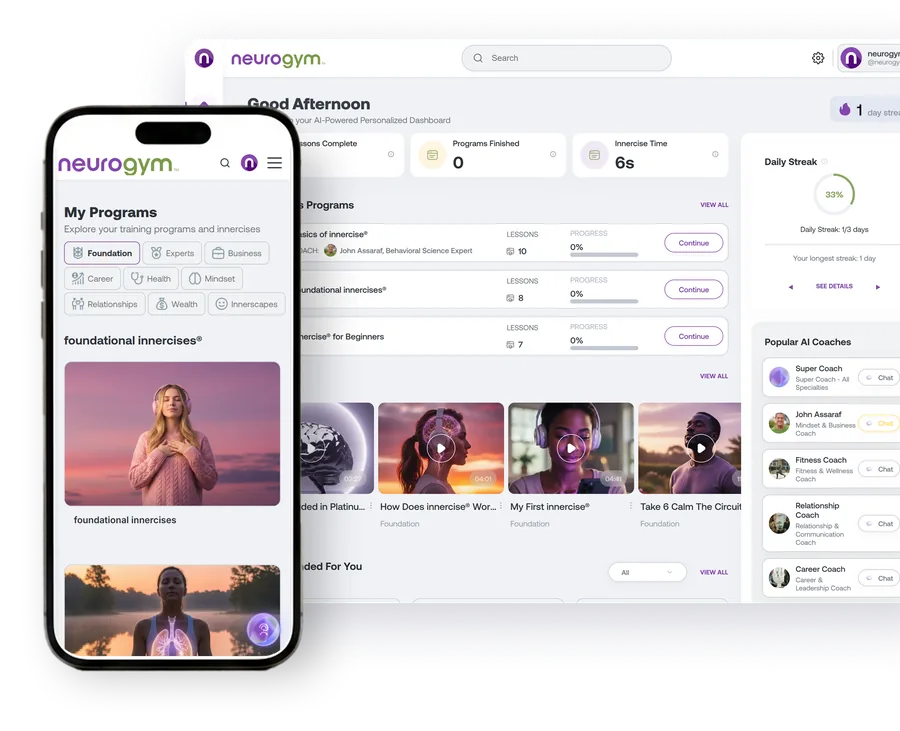
NeuroGym Platinum Review: Price, What You Get and the 7-Day Guarantee
John Assaraf’s top NeuroGym plan, checked against the official pricing and refund pages: what $97 a month or $497 a year buys, how it differs from Gold, and how the 7-day money-back guarantee works.
Read the review