Self-Sabotage: Why You Do It, the Role of Limiting Beliefs and How to Stop
Self-sabotage is behavior that gets in the way of goals you care about. Here is what it looks like, why it happens (including fear of failure and limiting beliefs), eight steps to stop it and a free training on retraining the patterns behind it.
Affiliate disclosure: This article contains affiliate links, which means I may earn a commission if you register through them, at no extra cost to you. This is an independent site, not the official NeuroGym website. NeuroGym is a trademark of its owner. This guide is educational: it is not medical or psychological advice, it does not diagnose or treat any condition, and it promises no result.
Quick answer
Self-sabotage is behavior that creates problems in daily life and interferes with long-standing goals. It often comes from fear of failure, doubt about your abilities or limiting beliefs you do not notice. You can interrupt it by tracking your patterns, finding the trigger and taking one small, planned step. NeuroGym offers a free training on retraining those patterns.
Pick a session time in your own time zone.
Highlights
- A clear definition of self-sabotage, with everyday examples
- Why people do it: fear of failure, protecting self-esteem and distorted beliefs
- What limiting beliefs are, with examples you can recognize
- Eight steps to stop self-sabotaging, one pattern at a time
- A section on self-sabotage in relationships and when to ask for help
- Free ways to go deeper: the NeuroFitness training and the Brainathon
| What it is | Behavior that creates problems and interferes with your own long-standing goals |
|---|---|
| Common forms | Procrastination, perfectionism, self-doubt, avoiding opportunities and pushing people away |
| Why it happens | Fear of failure, protecting self-esteem, avoiding discomfort and limiting beliefs |
| Best first step | Track when it happens and what you were thinking just before |
| What helps | One pattern at a time, small steps, self-compassion and support |
| Free way to go deeper | John Assaraf’s 75-minute NeuroFitness training and the live Brainathon 3.0 |
| NeuroGym program | Winning the Game of Fear, included with Platinum |
| Note | Educational, not medical or psychological advice |

What is self-sabotage?
Psychology Today describes behavior as self-sabotaging when it creates problems in daily life and interferes with long-standing goals. The key word is “your own”: the thing that gets in the way is something you do, or avoid doing, and people often do not realize they are doing it.
It is not the same as a mistake or a bad day. It is a pattern: you want something, and a habit, a thought or a choice keeps pulling you away from it.
What are examples of self-sabotaging behavior?
- Procrastination. Delaying the thing that matters most, often to avoid feelings of anxiety about it.
- Perfectionism. Never finishing or sharing something because it is not good enough yet.
- Self-doubt. Talking yourself out of opportunities before anyone else has a chance to say yes.
- Avoiding preparation. Leaving things to the last minute so there is a ready excuse if the result disappoints.
- Pushing people away. Pulling back in a relationship that is going well, out of fear of getting hurt.
- Comfort habits that crowd out goals. Choices that feel good now and work against what you want later.
Self-sabotage can show up in relationships, work, money, time management and the way you handle change. If you recognize two or three of these, you are not broken: you are noticing a pattern, which is the first step toward changing it.
Why do people self-sabotage?
The reasons vary, but they share one thread: the behavior protects you from something uncomfortable, even if it costs you in the long run.
- Fear of failure. If you never fully try, you can never fully fail.
- Protecting self-esteem. Psychologists call one version self-handicapping. Edward Jones and Steven Berglas described it in 1978 as creating or claiming obstacles in advance, so that a poor result can be blamed on the obstacle instead of on your ability.
- Avoiding anxiety. Procrastination, for instance, can be a way to escape distress about a task.
- Distorted beliefs. Patterns of thinking that lead people to underestimate themselves or expect the worst.
- Fear of emotional pain. In close relationships, pulling away can feel safer than risking loss.
Research on self-handicapping finds it is linked with lower performance, less persistence and lower motivation over time. That is the cost: the protection feels good in the moment, and the goal pays for it.
What is fear of failure?
Fear of failure is closely tied to what psychologists call fear of negative evaluation: apprehension about how others will judge you. David Watson and Ronald Friend defined the construct in 1969, and it is associated with anxiousness and avoiding social situations. In one basketball study, players high in this fear showed a significant drop in performance under pressure, while players low in it did not.
In everyday life, fear of failure is why people stay in jobs they have outgrown, abandon projects at ninety percent or never start the thing they dream about. It is common, and it is also one of the most trainable patterns, because it lives in how you think about outcomes.
What are limiting beliefs?
A limiting belief is a belief that restricts what you think is possible for you. It usually sounds like a fact, which is why it works so well in the background. Common examples:
- “I am not the kind of person who succeeds.”
- “If I try and fail, people will think less of me.”
- “People like me do not get those opportunities.”
- “I am not good enough, not ready, not smart enough.”
- “Good things never last.”
Limiting beliefs usually form early, from things we were told, saw or experienced, and they are repeated until they feel true. The good news is that a belief is a thought you have practiced, so it can be replaced by one you practice instead.
How do you stop self-sabotaging? Eight steps
- Track your patterns. For a week, note when you feel stressed, what set it off and how you responded. Patterns become visible once they are written down.
- Find your triggers. Pay attention to what you were thinking right before an uncomfortable feeling arrived.
- Pick one pattern. Choose the one that hurts you most and make a specific plan for the next time it shows up.
- Take small steps. Focus on incremental improvements, not a total overhaul. A small win repeated is more powerful than a big promise.
- Challenge the belief. Write the limiting belief down, then list real evidence against it, such as times you did succeed.
- Use mastery goals. Aim to learn and improve rather than to avoid looking bad. Research suggests this helps reduce self-handicapping.
- Be kind to yourself. Harsh self-criticism feeds avoidance. Treat a slip as information, not as a verdict.
- Get support. Talk to someone you trust, and consider a licensed professional, because therapy can help interrupt ingrained patterns.
Pick a session time in your own time zone.
How does the subconscious fit in?
John Assaraf’s NeuroGym teaches that many of our results follow subconscious patterns, the beliefs and habits we run without noticing, and that those patterns can be retrained with short, regular practice. That is the same idea behind the steps above: notice the pattern, then practice a new one until it becomes the default.
NeuroGym calls its daily practice an innercise, a guided session of visualization, meditation, affirmations or brain training that takes about five to fifteen minutes. Our neuroplasticity guide explains why repetition changes the brain, and our procrastination guide covers the most common form of self-sabotage.
What is the Winning the Game of Fear program?
Winning the Game of Fear is one of the programs NeuroGym includes with its Platinum membership, together with Winning the Game of Procrastination and Winning the Game of Money, 700+ innercises, 42+ AI coaches and four live trainings a month. Platinum is $97 a month or $497 a year on the official pricing page, and the platform carries a 7-day money-back guarantee. Our NeuroGym Platinum review goes through the plans.
Seating for the live sessions is limited.
What about self-sabotage in relationships?
In relationships, self-sabotage often comes from fear of emotional pain or loss: pulling away when things get close, picking fights or expecting rejection. Psychology Today suggests looking at the relationship patterns you learned early, journaling about your triggers, tolerating some discomfort, sharing your progress with your partner and practicing self-compassion. A licensed therapist can help you explore the fears behind it.
When should you ask for help?
Talk to a doctor or a licensed mental health professional if your patterns involve harming yourself, using alcohol or drugs to cope, or if they come with persistent low mood or anxiety. This guide is general information and does not replace care. If you are in distress in the United States, call or text 988, the Suicide and Crisis Lifeline.
Our verdict on how to stop self-sabotaging
Self-sabotage is a pattern, and patterns change with attention and practice. Track what happens, find the trigger, pick one pattern and take one small planned step. If you would like a guided way to retrain the beliefs underneath, John Assaraf’s free NeuroFitness training and the live Brainathon are a no-cost place to start.
What are the pros and cons of these strategies?
What stands out
- One pattern at a time, with small steps
- Based on how psychologists describe self-sabotage
- Free ways to go deeper with John Assaraf
- Works alongside therapy or coaching
- A 7-day money-back guarantee on the NeuroGym membership
Good to know
- Patterns change gradually: give it a few weeks
- Steps work best when you repeat them daily
- Pick one pattern to start, not all of them
- This guide is educational, not therapy
- Persistent patterns deserve a professional
Who is this self-sabotage guide for?
- You keep getting in your own way on goals you care about
- You recognize limiting beliefs or a fear of failure
- You want practical steps, not a diagnosis
- You prefer small daily changes to a big overhaul
- You want a free way to explore the mindset side
Start with the free NeuroFitness training or the Brainathon 3.0.
Pick a session time in your own time zone.
Seating for the live sessions is limited.
Check the price and terms on the checkout page.
Frequently asked questions about self-sabotage
What is self-sabotage?
Behavior that creates problems in daily life and interferes with your own long-standing goals, such as procrastination, perfectionism or avoiding opportunities.
Why do I self-sabotage?
Often to protect yourself from something uncomfortable, such as failure, judgment, anxiety or emotional pain. Distorted or limiting beliefs also play a part.
How do I stop self-sabotaging?
Track your patterns, find the triggers, choose one pattern and make a specific plan, take small steps, challenge the belief behind it, be kind to yourself and ask for support.
What are examples of self-sabotaging behavior?
Procrastination, perfectionism, talking yourself out of opportunities, avoiding preparation and pulling away from people who care about you.
What is self-sabotage in relationships?
Behavior driven by fear of emotional pain or loss, such as pulling away when things get close or expecting rejection. Journaling triggers and talking to a therapist can help.
What are limiting beliefs?
Beliefs that restrict what you think is possible for you, such as “I am not good enough.” They form early, are repeated until they feel true and can be replaced by practice.
What is fear of failure?
Apprehension about falling short, closely tied to fear of how others will judge you. It is common and can reduce performance under pressure.
Is self-sabotage a mental illness?
No. It is a pattern of behavior, not a diagnosis. If it comes with persistent low mood, anxiety or harmful coping, talk to a licensed professional.
What is Winning the Game of Fear?
One of the programs NeuroGym includes with its Platinum membership, alongside Winning the Game of Procrastination and Winning the Game of Money.
Is there a free way to try NeuroGym?
Yes. John Assaraf’s NeuroFitness training is a free 75-minute online session, and the live Brainathon 3.0 is free to attend. The membership has a 7-day money-back guarantee.
Related reviews
John Assaraf NeuroFitness Training: Free 75-Minute Class
John Assaraf’s free NeuroFitness training: what the 75-minute session covers on subconscious patterns, identity and the 5 pillars of financial success, how the sessions work and how to join.
Read the review
John Assaraf Brainathon 3.0 Review: Inside the Free Brain and Money Summit
Five brain and performance experts, three hours, no ticket price. What John Assaraf covers in Brainathon 3.0, and who gets the most from it.
Read the review
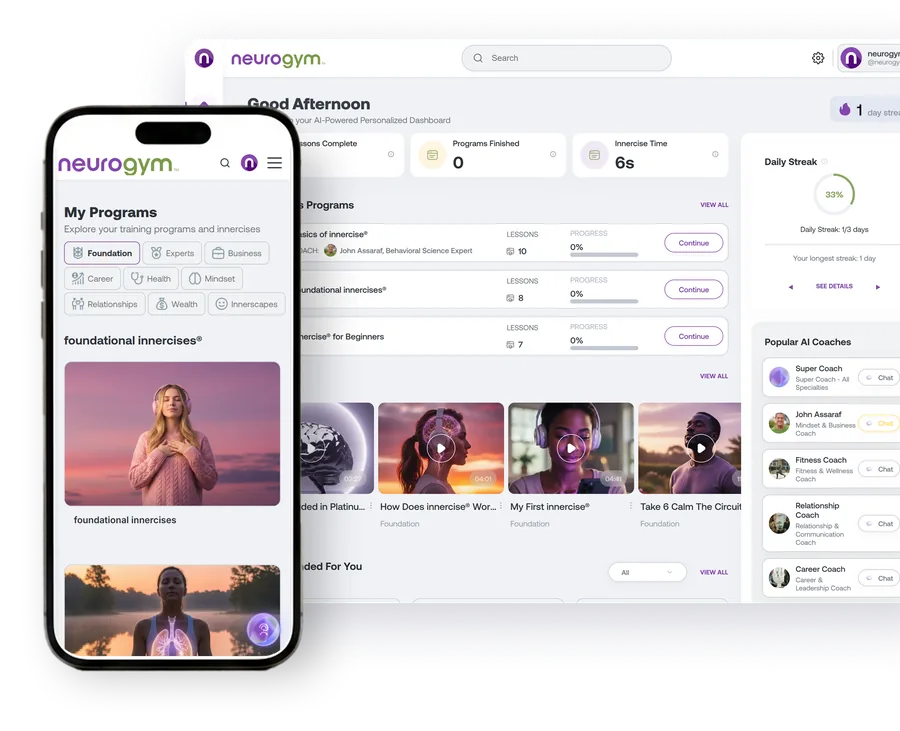
NeuroGym Platinum Review: Price, What You Get and the 7-Day Guarantee
John Assaraf’s top NeuroGym plan, checked against the official pricing and refund pages: what $97 a month or $497 a year buys, how it differs from Gold, and how the 7-day money-back guarantee works.
Read the review