Procrastination: What It Is, Why You Do It and How to Stop
Procrastination is delaying something you intend to do, even when you know it will cost you. Here is what research says about why it happens, nine ways to stop, and a free training from John Assaraf on the subconscious patterns behind it.
Affiliate disclosure: This article contains affiliate links, which means I may earn a commission if you register through them, at no extra cost to you. This is an independent site, not the official NeuroGym website. NeuroGym is a trademark of its owner. This guide is educational: it is not medical advice, it does not diagnose any condition, and it promises no result.
Quick answer
Procrastination is voluntarily delaying something you intend to do, even though you expect to be worse off for the delay. Research links it to avoiding uncomfortable feelings about a task, and it eases when you shrink the first step, plan when you will start and treat yourself kindly. NeuroGym offers a free training on the subconscious patterns behind the habit.
Pick a session time in your own time zone.
Highlights
- A clear definition of procrastination, from the research literature
- Why it happens: emotions, stress, impulsiveness and the task itself
- Nine practical ways to stop, from a two-minute start to a written plan
- Active and passive procrastination, and what “productive procrastination” means
- A short section on when to talk to a professional
- Free ways to go deeper: the NeuroFitness training and the Brainathon
| What it is | Voluntarily delaying an intended action despite expecting to be worse off for the delay |
|---|---|
| Common causes | Avoiding negative feelings about a task, stress, impulsiveness and tasks that feel unpleasant |
| How common | In one 2004 study, 70% of university students described themselves as procrastinators |
| What helps | Starting small, planning a start time, kindness toward yourself and building routines |
| Best first step | A two-minute start on the task you are avoiding |
| Free way to go deeper | John Assaraf’s 75-minute NeuroFitness training and the live Brainathon 3.0 |
| NeuroGym program | Winning the Game of Procrastination, included with Platinum |
| Note | Educational, not medical advice |

What is procrastination?
Procrastination is an avoidance behavior: unnecessarily delaying or postponing something even though you know there could be negative consequences. The psychologist Piers Steel, who reviewed earlier definitions in a 2007 meta-analysis, put it this way: to voluntarily delay an intended course of action despite expecting to be worse off for the delay.
Two parts of that definition matter. It is voluntary, meaning nobody is stopping you, and it is costly, meaning you expect to pay for it later. That separates procrastination from deliberate, strategic delay, such as waiting for better information before deciding.
Why do you procrastinate?
Research points to several causes that often work together:
- Avoiding feelings. Procrastination is often a way to escape uncomfortable emotions about a task, such as anxiety about starting or fear of getting it wrong.
- The task itself. People delay more on tasks that feel unpleasant or imposed than on tasks they like.
- Impulsiveness. Steel’s model treats impulsiveness as a key predictor: the pull of something enjoyable now beats a payoff later.
- Stress. When you are stretched, you have fewer resources to face a hard task, so avoiding it feels easier.
A 2023 review by Fuschia Sirois of Durham University, published in the International Journal of Environmental Research and Public Health, describes procrastination as a low-resource way of avoiding aversive and difficult task-related emotions, and finds it moderately associated with perceived stress across students, working adults and people with health conditions. The review also notes that the tendency is moderately heritable, and that context can change how strongly it shows. In other words, procrastination is partly about circumstances and feelings, not only willpower.
How common is procrastination?
Very. A 1984 University of Vermont study found that 46% of people said they always or nearly always procrastinated on writing papers, and about 30% did so on studying for exams and weekly reading. In a 2004 study, 70% of university students described themselves as procrastinators. If you do it, you are in good company.
What are the types of procrastination?
Researchers distinguish passive procrastination, where delay comes from indecision or avoidance, from active procrastination, where some people deliberately delay and then work well under the pressure of a deadline. The second kind is sometimes called productive procrastination, and it works for some tasks, but it is risky when the stakes are high or the deadline is not fixed.
How do you stop procrastinating? Nine strategies
- Name the feeling. Ask what you are avoiding: boredom, fear of failing, or not knowing where to begin? Naming it takes away some of its power.
- Shrink the first step. Commit to two minutes of the task, not the whole task. Starting is the hardest part, and momentum does the rest.
- Break the work into small blocks. Work for twenty-five minutes, then pause. Small blocks feel doable, and research recommends them over tackling a whole problem at once.
- Plan when and where you will start. A plan of the form “When X happens, I will do Y” makes starting automatic, a technique called an implementation intention.
- Remove one distraction. Put the phone in another room for your work block.
- Be kind to yourself. Self-compassion is linked to lower procrastination, while harsh self-criticism feeds the avoidance cycle.
- Practice mindfulness. A few minutes of focused breathing helps you notice the urge to avoid without acting on it.
- Build a routine. A fixed time each day, ideally in the morning, turns starting into a habit. Our morning routine guide shows how.
- Tie it to a reason. Write why the task matters to the person you want to become. A purpose is stronger than a deadline.
Cognitive behavioral therapy has shown the largest average effects in intervention studies, and a randomized trial of a two-week emotion regulation skills program significantly reduced procrastination at follow-up. If procrastination is hurting your work, health or relationships, a licensed professional can help.
Pick a session time in your own time zone.
What is the identity approach to procrastination?
John Assaraf’s NeuroGym looks at procrastination from the inside out. Its premise is that many results follow subconscious patterns, such as the beliefs and habits you do not examine, and that those patterns can be retrained with short, regular practice. NeuroGym’s free NeuroFitness training covers how subconscious patterns shape your results and how to upgrade your identity to match your goals.
The method NeuroGym uses is the innercise: a guided session of visualization, meditation, affirmations or brain training that takes about five to fifteen minutes. If you want to see how it works, the training is a no-cost place to start. Our neuroplasticity guide explains the science behind it.
What is the Winning the Game of Procrastination program?
Winning the Game of Procrastination is one of the programs NeuroGym includes with its Platinum membership, alongside Winning the Game of Fear and Winning the Game of Money, 700+ innercises, 42+ AI coaches and four live trainings a month. Platinum is $97 a month or $497 a year on the official pricing page, and the platform carries a 7-day money-back guarantee. Our NeuroGym Platinum review goes through the plans.
Check the price and terms on the checkout page.
Is procrastination a sign of ADHD or depression?
Procrastination alone is not a diagnosis. It is common, and almost everyone does it sometimes. Some people with ADHD or depression find it especially hard to start tasks, but delaying things does not mean you have either condition. If it is persistent, affects your daily life or comes with low mood, constant worry or trouble focusing, talk to a doctor or licensed professional. In the United States, you can call or text 988 if you are in distress.
Our verdict on how to stop procrastinating
Procrastination is a habit of avoiding feelings, and habits change with small, repeated steps. It is also one of the most common forms of self-sabotage, so that guide is a natural next read. Start with two minutes, plan when you will begin, be kind to yourself and give it a few weeks. If you want to go deeper, John Assaraf’s free NeuroFitness training and the live Brainathon show how subconscious patterns shape your results and how to retrain them.
What are the pros and cons of these strategies?
What stands out
- Small steps that take two minutes to start
- Based on what research says about why people delay
- Free ways to go deeper with John Assaraf
- A routine and a plan you can keep
- A 7-day money-back guarantee on the NeuroGym membership
Good to know
- Habits change gradually: give it a few weeks
- Strategies work best when you use them daily
- Choose one or two strategies and keep them going
- This guide is educational, not therapy
- Persistent cases deserve a professional
Who is this procrastination guide for?
- You keep putting off something you want to do
- You want strategies backed by research, in plain English
- You prefer small daily steps to a big overhaul
- You want a free way to explore the mindset side
- You want to build a routine that makes starting automatic
Start with the free NeuroFitness training or the Brainathon 3.0.
Pick a session time in your own time zone.
Seating for the live sessions is limited.
Check the price and terms on the checkout page.
Frequently asked questions about procrastination
What is procrastination?
Voluntarily delaying an intended action despite expecting to be worse off for the delay. It is a common avoidance behavior.
Why do I procrastinate?
Often to avoid uncomfortable feelings about a task, such as anxiety or fear of failing. Stress, impulsiveness and tasks that feel unpleasant also play a part.
How can I stop procrastinating?
Name what you are avoiding, start with just two minutes, break the work into small blocks, plan when you will start, remove a distraction and be kind to yourself.
Is procrastination a mental illness?
No. It is a common behavior, not a diagnosis. If it is persistent or comes with low mood or constant worry, talk to a licensed professional.
Is procrastination a form of ADHD?
Not by itself. Some people with ADHD find starting tasks hard, but delaying things does not mean you have ADHD. A doctor can assess it.
What is productive procrastination?
Doing other useful tasks while avoiding the main one, or active procrastination, where some people deliberately delay and work well near a deadline. It can work, but it is risky when stakes are high.
How common is procrastination?
Very common. In a 2004 study, 70% of university students described themselves as procrastinators.
What is the two-minute rule?
A tactic where you commit to just two minutes of the task you are avoiding. Starting is the hardest part, and momentum usually carries you further.
What is Winning the Game of Procrastination?
One of the programs NeuroGym includes with its Platinum membership, alongside Winning the Game of Fear and Winning the Game of Money.
Is there a free way to try NeuroGym?
Yes. John Assaraf’s NeuroFitness training is a free 75-minute online session, and the live Brainathon 3.0 is free to attend. The membership has a 7-day money-back guarantee.
Related reviews

John Assaraf NeuroFitness Training: Free 75-Minute Class
John Assaraf’s free NeuroFitness training: what the 75-minute session covers on subconscious patterns, identity and the 5 pillars of financial success, how the sessions work and how to join.
Read the review
John Assaraf Brainathon 3.0 Review: Inside the Free Brain and Money Summit
Five brain and performance experts, three hours, no ticket price. What John Assaraf covers in Brainathon 3.0, and who gets the most from it.
Read the review
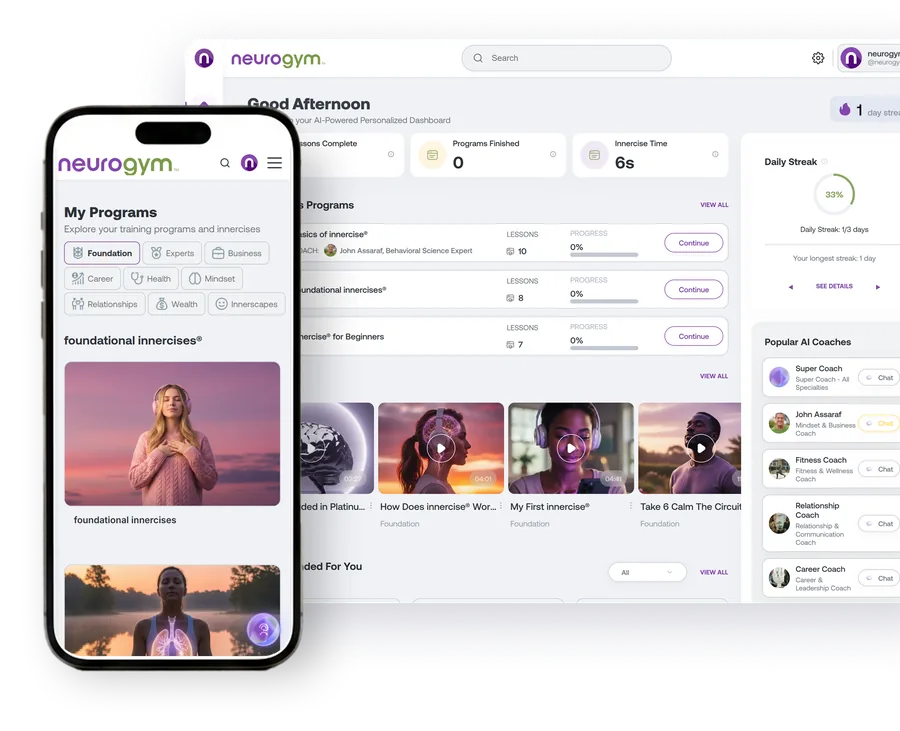
NeuroGym Platinum Review: Price, What You Get and the 7-Day Guarantee
John Assaraf’s top NeuroGym plan, checked against the official pricing and refund pages: what $97 a month or $497 a year buys, how it differs from Gold, and how the 7-day money-back guarantee works.
Read the review